Pluto’s Moon Charon just gave scientists an exciting surprise. Using the James Webb Space Telescope (Webb), researchers recently detected carbon dioxide on Charon, Pluto’s largest moon. This groundbreaking discovery reveals an even more complex chemical environment than we thought possible on this icy moon. Thus, it adds layers to our understanding of bodies beyond Neptune.
The new findings give us a glimpse into Charon’s unique composition and what these frozen worlds could have looked like billions of years ago.
These discoveries are thanks to a team from the Southwest Research Institute (SWRI), who built on previous data from NASA’s New Horizons mission. The Webb telescope’s powerful near-infrared spectrograph has brought Charon’s hidden details into sharper focus. Thus, painting a clearer picture of its chemical makeup.
Until now, scientists primarily viewed Charon as a frozen moon composed mostly of crystalline water and traces of ammonia. With carbon dioxide and hydrogen peroxide now identified on its surface, Charon’s story becomes much richer and more mysterious.
New Carbon Dioxide Discovery on Pluto’s Moon Charon
Carbon dioxide, a gas essential to life as we know it, is also now a key to understanding Charon’s history. On Earth, carbon dioxide is common in the air we breathe. But on Charon, finding it locked in the ice was unexpected. For Charon, a small moon located far beyond the warmth of the Sun, this discovery suggests that chemical reactions are taking place under extreme conditions.
Thus, this detection of carbon dioxide offers scientists new clues about the Kuiper Belt, a distant region full of icy bodies. Charon, on the edge of the solar system, is part of the Kuiper Belt’s rich and diverse collection of Trans-Neptunian Objects (TNOs).
Scientists believe these objects act as time capsules. They preserve the solar system’s original chemical makeup. So, by studying Charon’s carbon dioxide, researchers can better understand how it and other TNOs adapt to the harsh conditions of deep space.
Hydrogen Peroxide is Another New Discovery on Charon
In addition to carbon dioxide, scientists also found hydrogen peroxide on Pluto’s Moon Charon. Famous for its use as a disinfectant here on Earth, hydrogen peroxide on Charon presents an entirely different story. In this frigid environment, hydrogen peroxide could form through interactions between ice and solar radiation, creating a chemical layer over time.
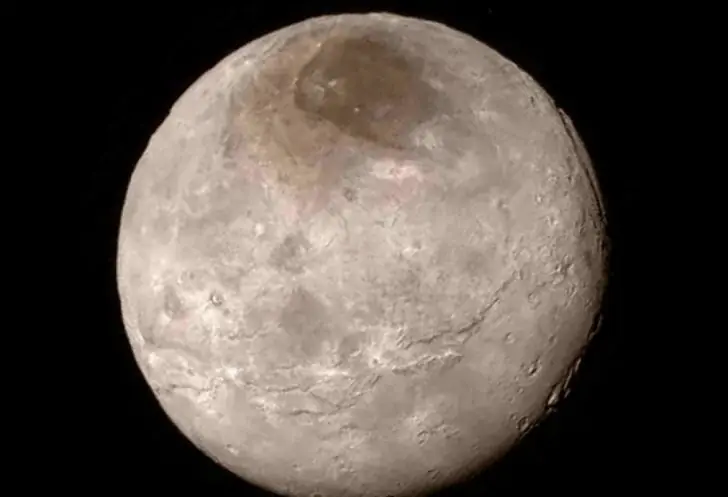
Instead, it points to an intriguing chemical dance where ice, solar radiation, and cosmic particles interact.
How the Webb Telescope is Transforming Our View of Charon?
The Webb Telescope’s advanced technology opens a new chapter in space exploration. And Pluto’s Moon Charon is one of its latest subjects. While previous missions like New Horizons provided a first glimpse, Webb’s near-infrared spectrograph reveals details of Charon’s surface with surprising clarity.
This tool allows scientists to identify compounds that were either too faint or complex for earlier telescopes to detect. For Charon, this means a closer look at every icy molecule on its surface, exposing secrets previously hidden beneath layers of frost.
Lead researcher Silvia Protopapa emphasizes the importance of identifying which chemicals on Charon are original and which are ‘altered‘ by time and cosmic factors. By separating these layers, scientists can piece together a clearer picture of the solar system’s primordial disk – the raw material from which planets, moons, and other bodies formed.