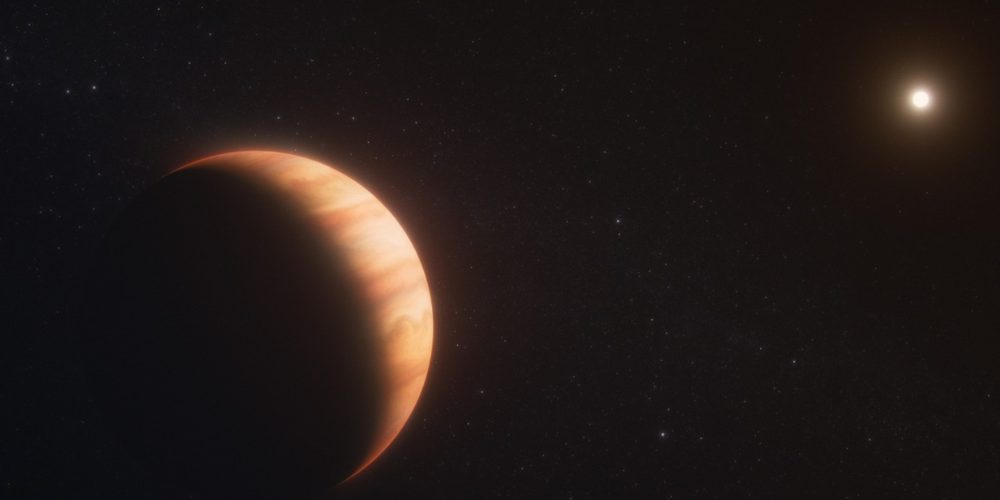
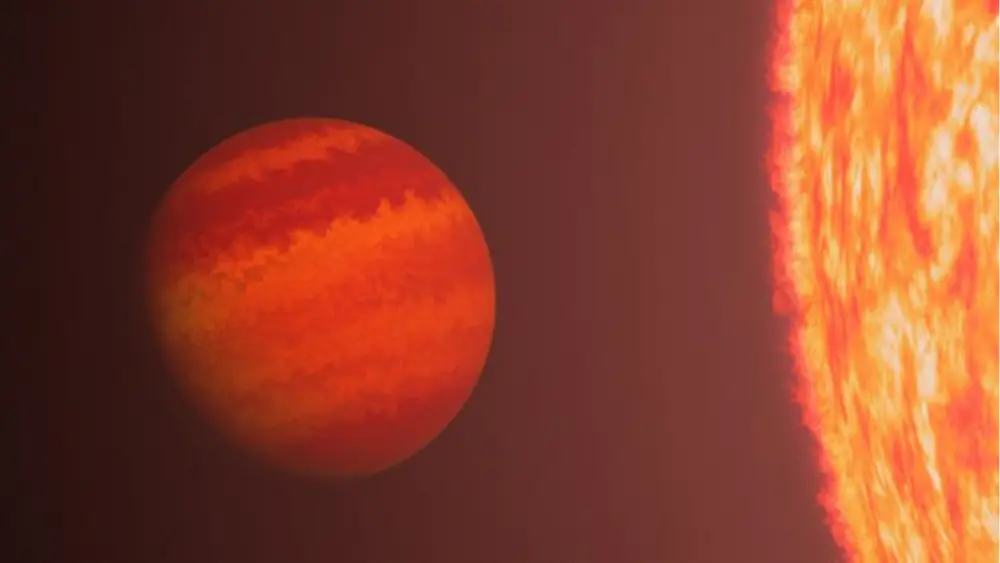
NASA’s exoplanet hunter, the Transiting Exoplanet Survey Satellite (TESS), has uncovered an extraordinary cosmic oddity. A strange planet, nicknamed Phoenix, clings to its atmosphere despite enduring unrelenting radiation from its red giant parent star. This discovery challenges what we know about planet survival, adding a remarkable chapter to the story of exoplanets.
Phoenix, officially named TIC 365102760 b, should not exist as it does. Located 1,800 light-years away, it lies uncomfortably close to its aging star, TIC 365102760. At this distance, any normal planet would have been stripped bare, yet Phoenix stubbornly retains its atmosphere.
Against all odds, this resilient planet thrives in a situation that should have rendered it a barren rock.
A Survivor in a Sea of Fire
Phoenix belongs to a rare group of planets known as “hot Neptunes.” These are worlds smaller than Jupiter but larger than Earth, orbiting dangerously close to their stars. What sets Phoenix apart is its incredible resistance to the harsh conditions of its environment.

The planet completes an orbit in just 4.2 Earth days, a fleeting year by cosmic standards. With a radius 6.2 times larger than Earth’s and a mass roughly 20 times that of our planet, Phoenix is unexpectedly low in density. Scientists estimate it to be 60 times less dense than the densest hot Neptune discovered so far.
This peculiar combination of age, size, and resilience makes it an incredible outlier.
The Fiery Star That Should Have Destroyed It
Phoenix orbits a red giant star nearing the end of its life. Red giants are the swollen remnants of once-stable stars that have exhausted their hydrogen fuel. So, when this transformation occurs, the star expands to a massive size, often swallowing nearby planets.
TIC 365102760 has already ballooned to 100 times its original width, radiating energy that would ordinarily strip a planet’s atmosphere within a few million years.
Yet, Phoenix has held on for an astounding 10 billion years. Its survival hints at a mysterious mechanism slowing the rate of atmospheric loss. This discovery rewrites our understanding of how close-in planets interact with their host stars and the limits of planetary endurance.
A Glimpse Into Our Future With Phoenix
The fate of Phoenix holds clues about what might happen to Earth in the distant future. In about 5 billion years, our sun will also become a red giant. It will swell outward, likely engulfing Mercury, Venus, and Earth. So, as this happens, the inner planets will face conditions similar to what Phoenix experiences now.

Advanced modeling of Phoenix’s atmosphere suggests that its resilience is due to a slower-than-expected rate of stripping. This finding raises important questions about how other planets might weather the expansion of their stars. It offers insights into the long-term evolution of planetary systems.
It Marks A Rare Discovery With Massive Implications
Phoenix’s discovery was made possible through TESS, which detects planets by observing the dips in light caused as they transit their stars. Finding smaller, puffier planets like Phoenix is a challenge because these light signals are faint.
However, by filtering out unwanted starlight and refining the data, astronomers unlocked the ability to spot such rare worlds.
TESS’s success with Phoenix proves that even the smallest, faintest signals can reveal significant planetary discoveries. It also highlights the growing sophistication of exoplanet detection methods, paving the way for more detailed studies of planets orbiting red giants. Scientists have already begun applying this technique to observe dozens of similar worlds.